Why RWA Is the Next Big Wave in DeFi
Canborsa Team
DeFi has already proven it can rebuild financial infrastructure without banks. But so far it has been rebuilding it for a relatively small pool of assets: cryptocurrencies worth a few trillion dollars. Real-world assets represent a market that is more than 100 times larger. The question is no longer whether RWA will transform DeFi. It is how fast.
Where DeFi started and where it stalled
Decentralized finance emerged around 2018 as a set of protocols that could replicate core financial services — lending, borrowing, trading, earning yield — without any centralized institution involved. By 2021, the sector had grown to over $180 billion in total value locked.
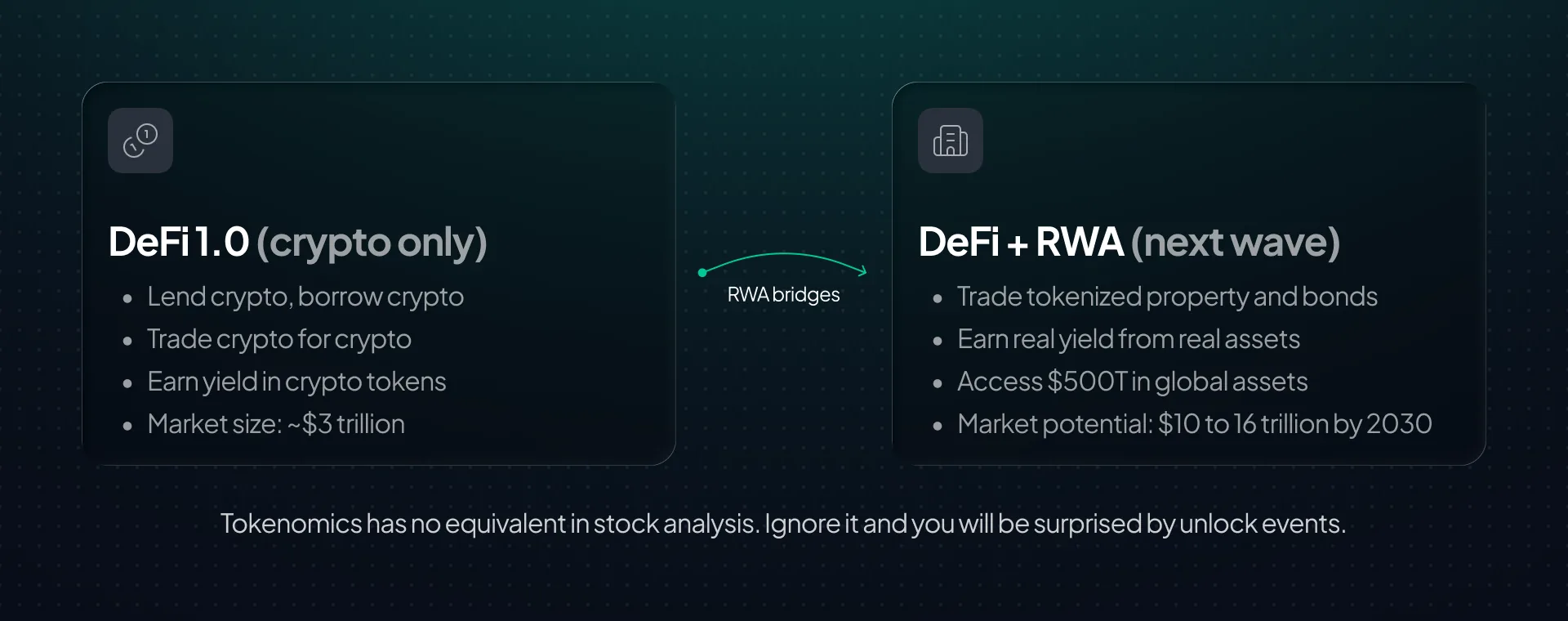
But almost all of that value came from one source: crypto assets. Bitcoin, Ethereum, stablecoins, and governance tokens. The entire DeFi ecosystem was, in effect, trading crypto and lending crypto with crypto.
That created a fundamental limitation. DeFi's growth was tied entirely to the performance of the crypto market. When crypto fell, DeFi fell with it. The sector had no connection to the real economy, the assets people actually owned, or the returns that existed independently of token prices.
The five forces driving the RWA wave
RWA is not a trend driven by hype. It is driven by five structural forces that are compounding simultaneously, each one accelerating the others.
1. Institutional capital is ready
The largest asset managers in the world have spent the past three years building blockchain infrastructure. BlackRock launched BUIDL, a tokenized money market fund, in March 2024. Franklin Templeton put its government money market fund on-chain in 2021. Fidelity, JPMorgan, and Goldman Sachs have all run tokenization pilots.
These institutions are not experimenting. They are preparing to move significant capital on-chain. When they do, the protocols and exchanges built for RWA will capture that flow. Canborsa is built precisely for this moment.
Tokenization of assets is the next generation for markets. — Larry Fink, CEO, BlackRock
2. Real yield exists outside crypto
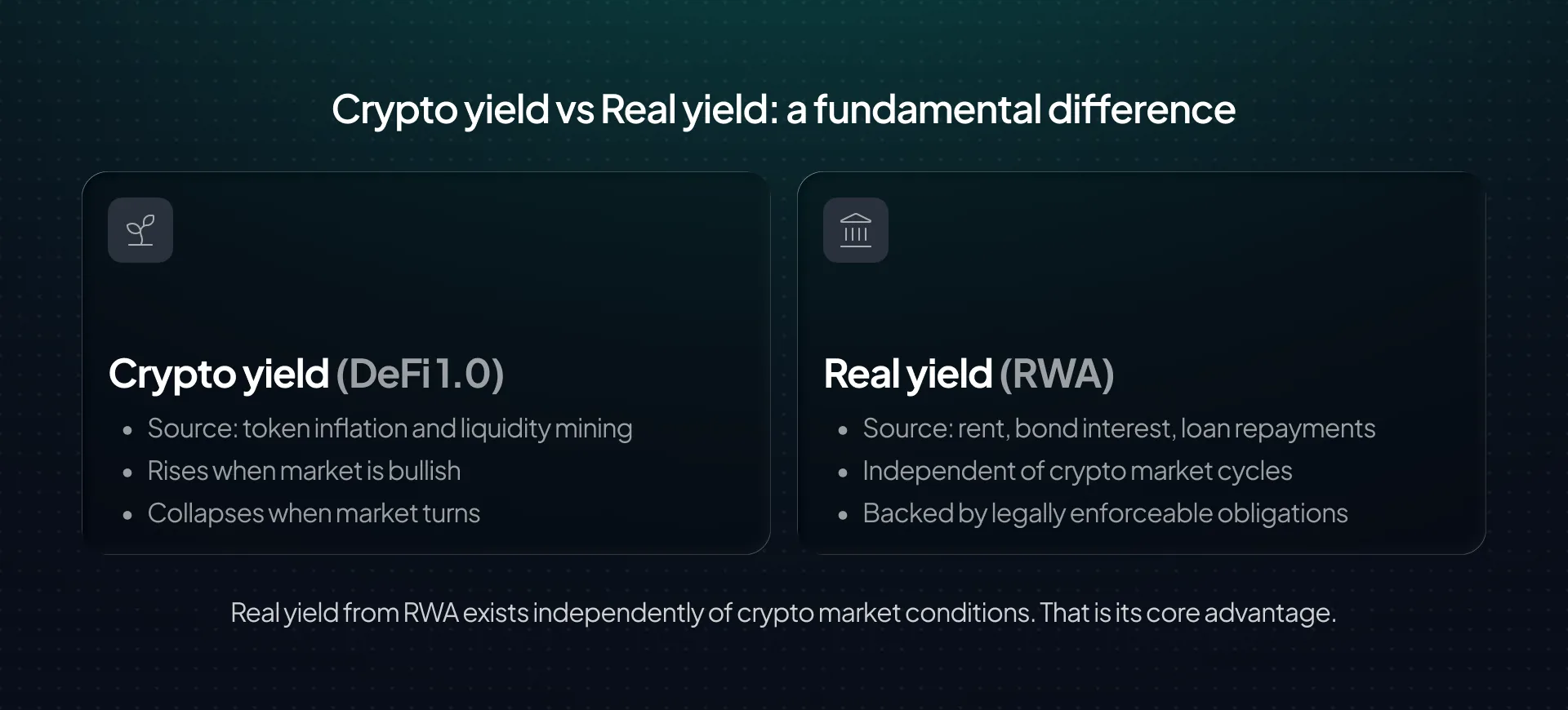
One of the most important developments in DeFi over the past two years is the rise of real yield: returns generated from genuine economic activity rather than token inflation.
When U.S. Treasury yields rose above 5% in 2023, it created a powerful opportunity. DeFi protocols could suddenly offer risk-averse investors access to government bond yields on-chain, without a brokerage account, without KYC in some cases, with instant liquidity. Protocols like Ondo Finance and Maple Finance grew rapidly by offering exactly this.
Real estate rental income, corporate bond coupons, private credit interest — all of these represent yield that exists completely independently of crypto market conditions. That is a fundamentally different value proposition than anything DeFi offered before.
3. Regulatory clarity is arriving
For years, regulatory uncertainty held back institutional participation in DeFi. That is changing. The EU's MiCA framework, the UK's Financial Services and Markets Act 2023, Singapore's MAS guidelines, and emerging frameworks in the UAE and Hong Kong are all creating clearer rules for tokenized securities.
Regulatory clarity does not slow RWA adoption. It accelerates it. Institutions that were waiting for legal certainty before committing capital now have a path forward.
4. Technology is mature enough
Three years ago, the infrastructure for RWA was not ready. Oracles were unreliable. Settlement was slow. Smart contract security was unproven at scale. Legal frameworks for SPVs holding tokenized assets barely existed.
Today, each of these has been solved or significantly improved. Chainlink and Pyth provide reliable real-world data feeds. Layer 2 networks have reduced gas costs by over 90%. Dozens of audited RWA protocols have operated without major incidents. Legal structures for tokenized assets are standardized in multiple jurisdictions.
5. The addressable market dwarfs crypto
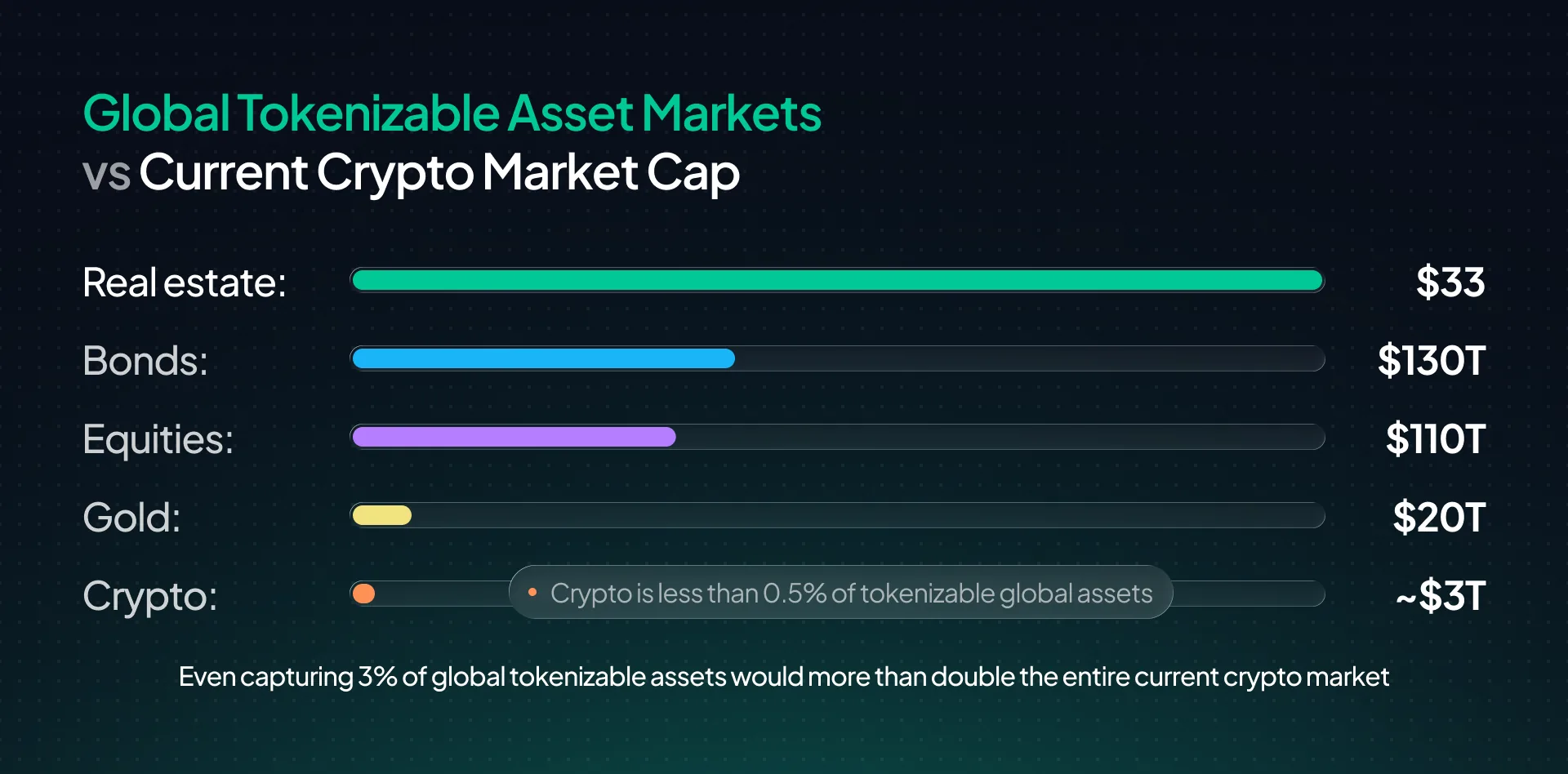
This is perhaps the most compelling structural argument for RWA. The total crypto market is approximately $2 to 3 trillion. The assets that can be tokenized are worth more than $500 trillion.
Who is already building in RWA
RWA is no longer a concept. It is a live and growing market with real capital, real users, and real institutions involved. Here are the key categories of players already active.
Institutional asset managers
BlackRock (BUIDL fund), Franklin Templeton (BENJI), Fidelity, and JPMorgan have all launched or piloted tokenized fund products. These are not experiments. BlackRock's BUIDL reached $2.6 billion.
Tokenized credit protocols
Maple Finance, Goldfinch, and Centrifuge connect DeFi liquidity with real-world borrowers: small businesses, emerging market lenders, and trade finance. Centrifuge alone has facilitated over $500 million in real-world asset financing.
Real estate tokenization platforms
RealT, Lofty, and others have tokenized hundreds of properties, allowing investors to buy fractional ownership from as little as $50. Rental income flows on-chain to token holders daily or weekly.
Tokenized Treasury providers
Ondo Finance (OUSG), Superstate, and OpenEden offer on-chain access to U.S. Treasury yields. Combined TVL across tokenized T-bill products surpassed $1 billion in 2024, growing faster than almost any other DeFi category.
Canborsa DEX
A multichain perpetual DEX supporting Canton, Ethereum, Base, Arbitrum, and BNB Chain. Canborsa brings tokenized real-world assets, crypto, swaps, and perpetual trading into a single non-custodial interface, available 24/7 with no brokers or KYC. Available markets include tokenized U.S. stocks (Apple, Nvidia, Tesla, SpaceX), Asian tech, commodities (Gold, Silver, Brent Oil), the S&P 500 index, and major crypto pairs. Built on Canton Network, the institutional-grade blockchain used by DTCC, Goldman Sachs, and BNP Paribas. Canborsa calls its vision AllFi: bringing traditional assets, crypto-native markets, and 24/7 liquidity into one financial environment.
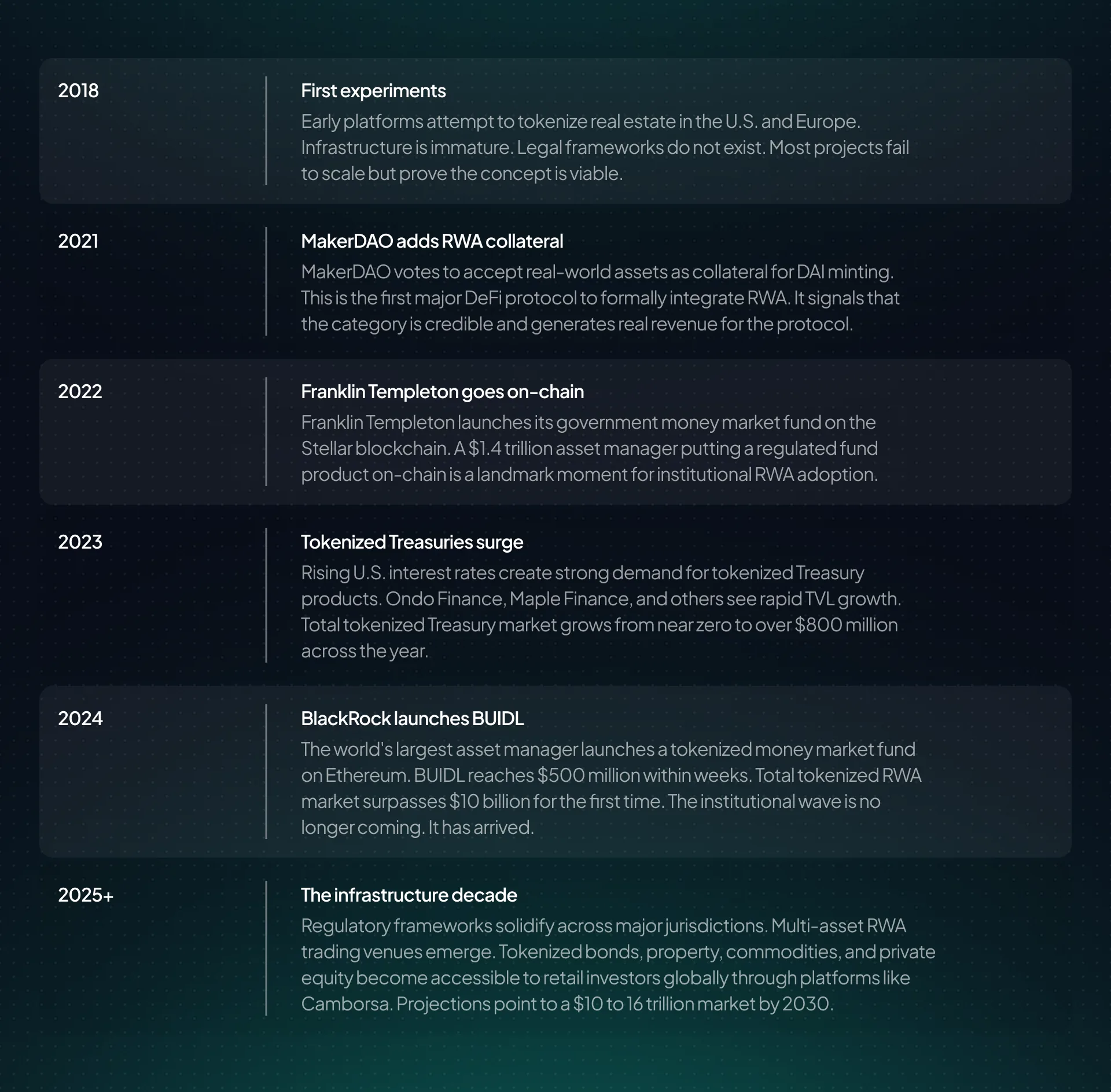
The RWA opportunity timeline
RWA has not appeared overnight. It has been building for years, with each milestone laying the groundwork for the next.
What RWA unlocks that crypto alone cannot
Access to $500T in real assets
For the first time, anyone with a wallet can own a fraction of a commercial property, a government bond, or a commodities fund without a broker or minimum investment threshold.
Yield independent of crypto cycles
Rental income, bond coupons, and loan interest exist whether Bitcoin is at $100,000 or $60,000. RWA gives DeFi a yield engine that does not rely on token inflation.
Composability with DeFi
Once on-chain, a tokenized bond can be used as collateral for a loan, traded on Canborsa, or plugged into a yield strategy. No equivalent of this exists in traditional finance.
24/7 settlement in seconds
Traditional asset transfers settle in two to five business days. Tokenized asset transfers settle on-chain in seconds, any day of the week, in any timezone.
Transparent ownership records
Every ownership change, yield payment, and transaction is recorded permanently on the blockchain. No opaque back-office processing, no reliance on a custodian's word.
Borderless participation
A property in Dubai can be co-owned by investors in 50 countries simultaneously. No foreign brokerage accounts, no currency conversion delays, no geographic restrictions on access.
Where Canborsa DEX fits in the RWA wave
Canborsa brings tokenized real-world assets, crypto markets, and perpetual trading into a single non-custodial interface, accessible 24/7 without brokers, business hours, or lengthy KYC.
The available markets reflect this vision directly. On Canborsa you can trade tokenized U.S. stocks including Apple, Nvidia, Tesla, and SpaceX. You can access Asian tech and semiconductor exposure through BABA and TSMC. You can trade Gold, Silver, Brent Oil, and the S&P 500 index. You can go long or short on crypto with up to 30x leverage on perpetual contracts. All from the same wallet, across Canton, Ethereum, Base, Arbitrum, and BNB Chain.
Canborsa is built on Canton Network, the institutional-grade blockchain used by DTCC, Goldman Sachs, and BNP Paribas, which provides privacy and atomic settlement at the level traditional finance requires.
Canborsa calls this vision AllFi: one environment where traditional assets, crypto-native markets, and 24/7 liquidity coexist. DeFi solved access to money. Canborsa solves access to real-world assets.
Key takeaways
- DeFi 1.0 was limited to crypto assets worth $2 to 3 trillion. RWA connects DeFi to over $500 trillion in real-world assets: property, bonds, gold, private credit, and more.
- Five structural forces are driving the RWA wave: institutional readiness, the rise of real yield, regulatory clarity, mature technology, and the sheer scale of the addressable market.
- Major institutions including BlackRock, Franklin Templeton, and JPMorgan are already active. BlackRock's BUIDL fund reached $500 million within weeks of launch.
- Real yield from RWA (rent, bond interest, loan repayments) exists independently of crypto market cycles. This is DeFi's most important new value proposition.
- The tokenized RWA market is projected to reach $10 to 16 trillion by 2030, according to BlackRock, McKinsey, and the World Economic Forum.